Pages

Showing posts with label BQ. Show all posts

Saturday, May 31, 2014

BQ#7- Unit V

                             Unit V Big Questions

Where does the formula for the difference quotient come from? Well know i now this question because i learned it from the wonderful Mrs. Kirch :D

       In this graph, we can see our understanding of where the difference quotient is derived from. The first point is (x, f(x)). There is delta x  and delta equals change in distance between the first and second point meaning the second point is (x + delta x, f(x + delta x)) that is what they used delta x but, for this we will reference to delta x as 'h' so our second point can also be written as (x+h, f(x+h) so that we can get a better understanding of a variable that we know so it wont be so confusing. The line that touches the graph at two points is called the secant line, very different from a  tangent line that only touches the graph once. To find the slope of the secant line we are going to use the slope formula. The slope formula is m = y2-y1 all divided by x2-x1. When we plug in our two points from the first graph we have f(x + delta x) - f(x) all over x + delta x - x. Then we substituted h for delta x and we get f(x+h) - f(x) all over x + h -x. Then we notice in the denominator we have a x and -x and what happens when you get a positive and negative number or variable is this case variable you CANCEL THEM, leaving only h. Then you get the Difference quotient f(x+h) - f(x) divided by the letter h, that's the difference quotient :D
There is a video that verbally shows you how to derive the difference quotient by clicking here


                                                     Works Cited 


Sunday, May 18, 2014

BQ#6- Unit U Concept 1-8

              Unit U Big Questions

1) What is continuity?
 Continuity is when something does not stop or is not interrupted by anything. A continuous function is predictable. It has no breaks in the graph, no holes, and no jumps. A function that is continuous can be drawn with a single, unbroken pencil stroke. In terms of limits, a function is continuous if the limit as x approaches a number of f(x) is equal to the height f(x) that reaches at that point.
This is a picture of a function that goes on forever in both directions and is not interrupted by anything, meaning there are no jumps, holes, or breaks in the graph.
What is discontinuity?
Discontinuity is when something doesn't go on forever in both directions and is not continuous. There are two families of discontinuous functions. They are removable and non-removable discontinuities. The removable discontinuity is just called point discontinuity, also known as a hole. The non-removable discontinuities are jump discontinuity, oscillating behavior, and infinite discontinuity, which is known as unbounded behavior and occurs where there is a vertical asymptote. The removable also means that there is going to be a limit that does exist while at non-removable discontinuities there all going to be the limit does not exist.

Removable: 


Non-removable:


2) What is a limit?  When does a limit exist? When does a limit not exist?  What is the difference between a limit and a value?
A limit is the intended height of a function. A limit exist when you reach the same height from both the left  and the right of the graph which only happens in a point discontinuity. A limit does not exist when its in the non-
removable family. Jump discontinuity DNE b/c of different L/R. Oscillating Behavior b/c of oscillating behavior, theres no name for it, and Infinite discontinuity b/c of unbounded behavior. The difference between a limit and a value is that, a limit is the intended height and the value is the actual height on a graph.

3) How do we evaluate limits numerically, graphically, and algebraically?
We evaluate limits numerically by using a table. With the table, we find the intended heights of the whole function. 


To evaluate limits graphically, we plug in our function into the y= screen on our graphing calculator, hit trace, and trace to the value we are looking for. If you hit trace and you don't get a value, the limit does not exist and the reasons for that situation are those three reasons.
Lastly, we evaluate limits algebraically by using three different methods: 

Direct substitution method
In which you just plug in the numbers that is approaching the limit of f(x) and solve it. You can get either a numerical answer, 0/# which equals to ZERO, #/0 which is UNDEFINED so the limit DNE,and if you get 0/0 it is a indeterminate form so then you have to use the next method which is divide and factor method.
Dividing out/Factoring method
We use this method when we get indeterminate form. We then factor both the numerator and denominator and cancel the common term to remove the zero in the denominator. Then we use direct substitution with the simplified expression. BUT always be sure to use direct substitution first!!
Rationalizing/Conjugate method
This method is also helpful with a fraction, especially if it has radicals. You multiply by the conjugate of either numerator or denominator depending where the radicals are at, then FOIL the conjugates and DO NOT multiply out the non-conjugate part, leave it factored because you then get something canceled out which is a good thing and then you simplify and once again use direct substitution with the simplified expression.


                           WORK CITED

Sunday, April 20, 2014

BQ#4- Unit T- Concept 3

Why is a "normal" Tangent uphill, but a "normal" Cotangent graph downhill? Use unit circle ratios to explain.
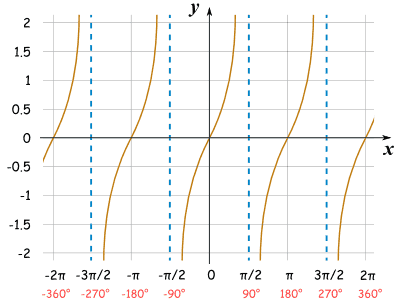
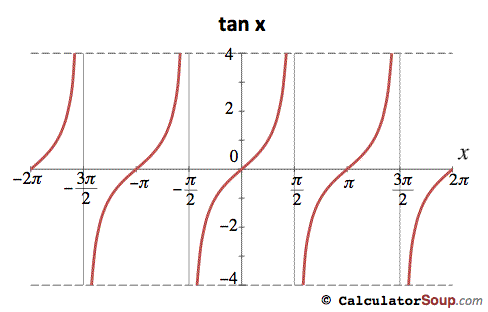
According to the unit circle, tangent is positive in the first and third quadrants which is why on the graph, tangent is above the x axis which is positive from 0 to pi/2 and pi to 3pi/2. Also because the asymptotes for tangent are pi/2 and 3pi/2, that explains why tangent is going towards the asymptotes meaning that because tangent stops being positive at the end of the first quadrant it goes toward the asymptote to finish the cycle and then starts going negative to start the second quadrant and so on. That is why a normal tangent graph is uphill at one period.

http://www.mathsisfun.com/algebra/images/tangent-graph.gif

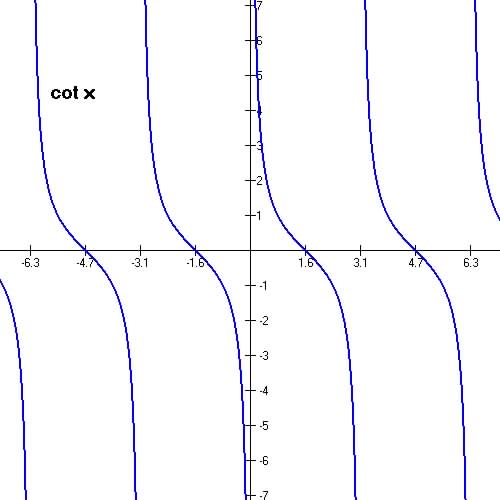
According to the unit circle, cotangent is positive in the first and third quadrants just like tangent that is why on the graph, cotangent is also above the x axis (positive) from 0 to pi/2 and pi to 3pi/2. Also, because the asymptotes for cotangent are 0 and pi, that explains why cotangent is going towards those asymptotes, which means that cotangent stops being positive at the end of the first quadrant going towards the asymptote to finish the cycle and then starts going negative to start the second quadrant and so on. Another reason why it is downhill is also because it is the inverse of tangent so the direction is almost like a mirror image going in a different direction since they are reciprocals of each other since they have different asymptotes it changes the pattern of the graph which makes it go downhill this time instead of uphill. That is why Cotangent is going downhill.


https://algebra2c.wikispaces.com/file/view/Cotangent(X).png/34612489/Cotangent(X).png


                                    WORKS CITED PAGE

TANGENT
COTANGENT


Friday, April 18, 2014

BQ#3 Unit T Concepts 1-3

2) How do the graphs of sine and cosine relate to each of the others? Emphasize asymptotes in your response.Well, sine and cosine don't have asymptotes but the rest of the trig functions do have asymptotes because at certain marks on the graph, sine can be 0 and cosine can be 0. These two functions relate to the others because all of the others have sine or cosine within them in one way or another.  

a) Tangent 

tangent is sine/cosine so when cosine is 0 that means that the trig function is undefined so there is an asymptote. The Tangent's asymptotes are at pi/2 and 3pi/2.


http://mythi-trig.fateback.com/images/basicall.gif

b) Cotangent 
cotangent is the inverse of tangent which means because tangent is sine/cosine, cotangent is cosine/sine. When sine is 0 there is an asymptote because the whole thing is going to be undefined at that moment. Tangent's asymptotes are at pi/2 and 3pi/2 so, to contrast, this means that cotangent's asymptotes are at 0 and pi. Using the graphs you notice how the asymptotes of the graph of y = tan(x) are the x-intercepts of the graph of y = cot(x). There are vertical asymptotes at each end of the cycle.  The asymptote that occurs at pi repeats every pi units.


http://image.tutorvista.com/content/feed/u1593/cotangent.GIF

c) Secant 
secant is the inverse of cosine which means that it is 1/cosine and when cosine is 0, secant becomes undefined as a whole since it is the reciprocal of cosine. Anytime we have an undefined as our answer, we automatically know that there is going to be an asymptote, there are vertical asymptotes.  The asymptote that occurs at pi/2 repeats every pi units.


http://www.analyzemath.com/trigonometry/graph_cosecant.gif

d) Cosecant 
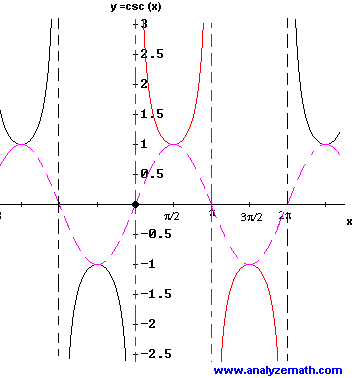
cosecant is the reciprocal of sine making cosecant 1/sine so when sine is zero, cosecant becomes undefined anytime sine is zero resulting in an asymptote. The x-intercepts of y = sin x are the asymptotes for y = csc x. There are vertical asymptotes.  The asymptote that occurs at pi repeats every pi units.


http://www.scs.sk.ca/cyber/elem/learningcommunity/math/math30c/curr_content/mathc30/GRAPHICS/RECIPROCAL_GRAPHS/MOVIE8.GIF                                                                                                  WORKS CITED PAGE
TANGENT
COTANGENT
SECANT
COSECANT


Wednesday, April 16, 2014

BQ#5:Unit T- Concepts 1-3

1.) Why do sine and cosine NOT have asymptotes, but the other four trig graphs do? Use unit circle ratios to explain. 

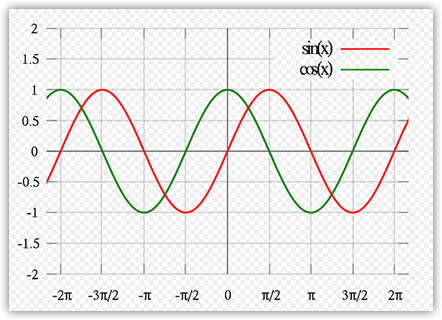
Sine and cosine do NOT have asymptotes because that is how they are, they are in a wavy line when they are fully done in the graph and they run infinite on the x-axis. It refers to the unit circle because the ratio for cosine is x/r and since r is always 1 cosine can never be undefined since r can never be zero which is what makes a function undefined when the denominator is zero . The same goes for sine, in the unit circle the ratio for sine is y/r and since r is always 1 sine can never be undefined since r can never be zero, which is what is needed if you want to result in an asymptote to get that you need the denominator to be zero.

http://www.kirupa.com/developer/animation/images/cosinegraph.jpg

Cosecant, Secant, Tangent, and Cotangent all have asymptotes because of how x and y are zero in this case. Going back to the identities we know that secant is 1/cos which is, using the ratio of secant which is r/x. X can be any number and when it is zero secant automatically becomes undefined and when it is undefined we know that its going to have a asymptote. The same goes for cosecant, which is r/y, except that when y is cosecant it becomes  undefined and has an asymptote. Tangent is sin/cos so when cosine is 0 it becomes undefined and makes an asymptote. The same goes for cotangent except that since cotangent is cos/sin, when sine is 0  cotangent becomes undefined and makes an asymptote as well. 


http://www.mathipedia.com/GraphingSecant,Cosecant,andCotangent_files/image014.jpg

http://www.mathipedia.com/GraphingSecant,Cosecant,andCotangent_files/image008.jpg


http://www.pindling.org/Math/Learning/Ti_Calculator/Inverse_Trigs/3ac34ecf.jpg

http://www.calculatorsoup.com/images/trig_plots/graph_tan_pi.gif


                             WORKS CITED PAGE
IMAGE
Secant Asymptote
Cosecant Amplitude

BQ#2-Unit T Concept Intro: Trig Graphs and the Unit Circle

1.)How do the trig graphs relate to the Unit Circle?
well the trig graphs relate to the unit circle because we are still using the unit circle but it is now in a line this time and you still have the quadrants there but its just different it practically everything the same in the unit circle just that we don't use the degrees as an x-axis because when you put it in your graphing calculator you wont be able to see the whole thing of what you want only a little bit of it so that's why we use radians instead but everything else relates to the unit circle.
a)Period? - Why is the period for sine and cosine 2pi, whereas the period for tangent and cotangent is pi?
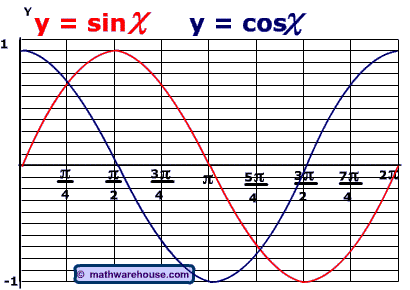
The period for sine and cosine is 2pi because that is how long it takes to repeat it, their pattern  doesn't repeat after four marks. On the unit circle the quadrant angles are (0,90,180,270, 360)  but we like to do (0, pi/2, pi, 3pi/2, and 2pi) because as i told you its better that way when it comes to plugging it in the calculator you can actually see a snap shot of it that is good enough. Sine is positive in quadrant 1 and quadrant 2, and negative in quadrant 3 and 4 which makes the pattern (+ + - -). Cosine is positive in quadrant 1 and quadrant 4, and negative in quadrant 2 and 3 which makes the pattern (+ - - +). When you see it on the unit circle the pattern for these two trig functions repeats only after one full revolution and since one revolution around the unit circle is 360 degrees it has a period of 2pi. If it was one period on a graph it's like saying one revolution on the unit circle. 

http://www.mathwarehouse.com/trigonometry/systems-sine-cosine-functions/images/picture-system-sinex-cosx.gif

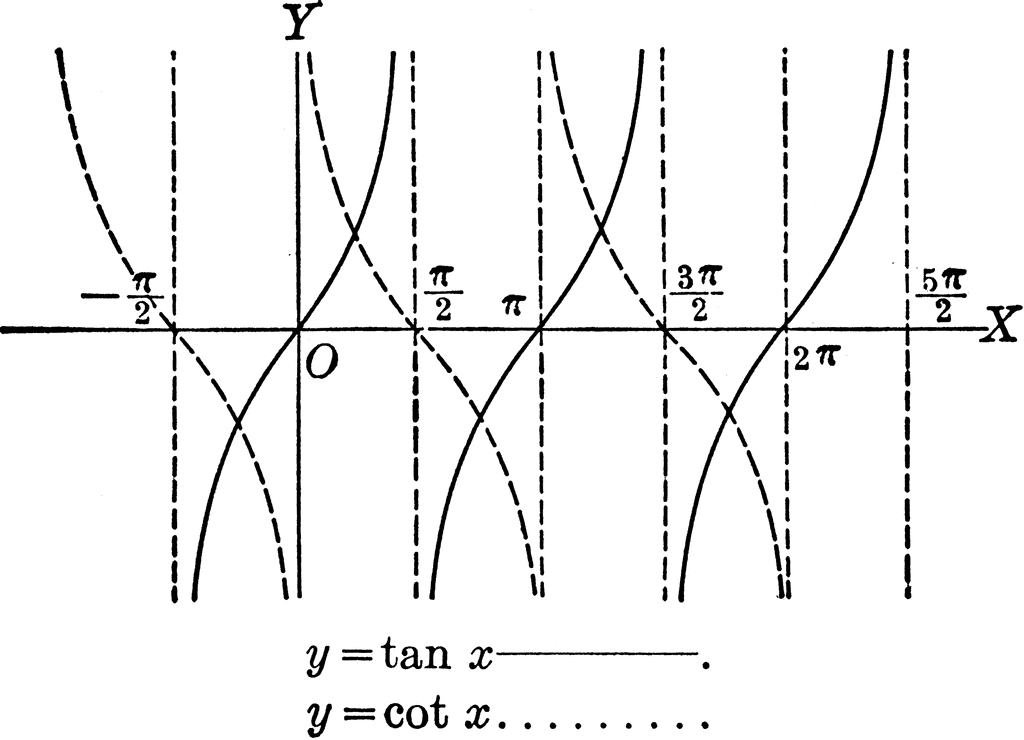
Tangent and Cotangent have a period of pi because their pattern of being positive or negative only repeats after two marks or half of a revolution. Tangent is positive in quadrant 1 and 3 and negative in quadrant 2 and 4. Cotangent is the same which means that both of the patterns are (+ - + -). When it comes to putting it on the graph you can notice after every two marks that tangent repeats. 

http://etc.usf.edu/clipart/36700/36731/tancotan_36731_lg.gif

B) Amplitude?-How does the fact that sine and cosine have amplitudes of one (and the other trig functions don't have amplitudes) relate to what we know about the Unit Circle?
sine and cosine have amplitudes of one because sine and cosine have restrictions that can't be greater than 1 or less than -1 so that is where the lowest point (-1) and the highest point (1) should be in the graph, relating to using the unit circle when sine=0 it should equal to one by using the ratio of sine to find out that it is one and when you do cos=0 that should equal to -1. Tangent and the rest of the trig functions do have an assymptote so when the functions are graphed in between the asymptotes the vertex indicates where the function begins to go up to infinity or down to negative infinity.

http://www.teacherschoice.com.au/Maths_Library/Functions/sine_function.gif

source: http://www.education.com/study-help/article/pre-calculus-help-other-trig-functions/


                                                      Works Cited Page
sine and cosine
Tangent and Cotangent
Image
IMAGE


Sunday, March 16, 2014

BQ#1: Unit P Concept 1 and 4: Law of Sines and Area Formula

1.) Law of Sines- Why do we need it? How is it derived from what we already know?
       The Law of Sines is needed to solve triangles that are not right triangles. The normal trig functions are defined for a right triangle and are not directly useful in solving non right triangles but we can use the trig function to determine the law of sines. So first you have a non right triangles labeled as ABC. Then you make a imaginary perpendicular line from angle B and we call that h. Now we have formed two triangles. Now we use the trig function of sin which is hypotenuse over adjacent and then on the other triangle we have the same as well but we don't know the numbers so for the triangle on the left side it is SinA=h/c and for the right it is SinC=h/a. We then want h by itself so we multiply by c and on the other by a and we get cSinA=h and the other aSinC=h then we equal them together cSinA=aSinC and you divide by ac and you get SinA/a=SinC/c and that is exactly what the law of sines is.

To get a picture in your head of how to do it instead of me telling you there is a video here.

4.) Area Formula- How is the "area of an oblique" triangle derived? How does it relate to the area formula that you are familiar with? 
       The area formula is derived from the area equation and the trig function. The area equation you should know form Geometry is A=1/2bh where b is the base and h is the height. We then draw a perpendicular line on triangle ABC in half from angle B to create two triangles with a sharing side of h. We then know that SinC=h/a and when you get h by itself you get h=aSinC. Then you substitute it in the area equation for h and we get A=1/2b(aSinC). The area of an oblique triangle is one half of the product of two sides and the Sine of their included angle.

To get a visual in your head of how it should look like and example problems as well watch this video here.
      It relates to the area formula by using 1/2bh as a start to find the area formula for an oblique triangle. We still use 1/2 and it still consists of two sides and the base for b but we have to find our own h by using the trig function of sine.

Works Cited
http://www.youtube.com/watch?v=zJsw_ltZxFo
http://www.youtube.com/watch?v=gAX_IleqeJQ